 BIRCH COVE BUILDERS
Switches, outlets and lighting.
Switches, outlets, lighting and the wiring decisions that have to be made before the walls close.
- Decide before wiringWhere everything goes, the type of recessed lights, smart controls, a generator, and any data or speaker wiring.
- Can wait until finish workSwitch and outlet style, device color and wall plates. These go in near the end of the job.
The common types of switches
Styles you can choose
- Toggle The classic flip-up lever. Simple, familiar and suits older or traditional homes.
- Rocker (decorator) A wide flat paddle you press at the top or bottom. The most common style in new homes. Leviton Decora is one well-known line.
- Rotary dimmer A round knob you turn to dim and push to switch. An older look that still suits some rooms.
- Rocker dimmer with slider Press to turn on and off; the side slider sets brightness and stays where you left it. Lutron Diva is a common example.
- Push-button Two buttons, one for on and one for off. A reproduction of early 1900s switches, used in period homes and cottages.
- Tap or smart dimmer A flat face you tap to turn on, off or brighter, with small lights that show the level. Most smart dimmers look like this.
How it's wired
Single-pole
One switch controls a light from one spot. Most switches in a house are single-pole.
3-way
Two switches control the same light, like at the top and bottom of a stair or at both ends of a hallway. The name is confusing; a "3-way" means two locations.
4-way
Three or more switches control the same light, for a long hall or a room with three doors. It uses two 3-way switches plus a 4-way for each location in between.
Other switches worth knowing about
Lighted and pilot switches
A small light shows where the switch is in the dark, or shows that something out of sight, like an outdoor light, is on.
Timers
Runs a bath fan for a set time, then shuts it off.
Fan speed controls
Separate wall controls for a ceiling fan's speed and its light, or one combined control.
Occupancy sensors
Turns the light on when you walk in and off after you leave. Good for closets, pantries and garages.
Switches that share a plate need to be the same style. Rockers, decorator outlets and most smart dimmers share one opening, so they mix easily.
Device colors and wall plates
The switch or outlet itself (the "device") and the cover around it (the "plate") are chosen separately. Most homes use one device color throughout, with plates that match the devices.
Common device colors
- WhiteThe default in most new homes.
- Light almondA soft beige for warm wall colors.
- IvoryCreamier and a bit more yellow than almond.
- GrayBlends with gray walls and stone.
- BlackFor dark walls, or as a design accent.
Screen colors are approximate. We can bring samples to look at on your walls.
Stick with one brand
One brand's ivory or almond doesn't exactly match another's, so the whole house stays in one brand.
Smart devices
Smart dimmers come in fewer colors. If you want both smart controls and a less common color, check they go together first.
Wall plates
Plastic
The standard, in the same colors as the devices.
Screwless
Snaps onto a hidden sub-plate, so no screws show.
Metal
Stainless, nickel, bronze, brass or black, often matched to cabinet hardware or fixtures.
LED cans, cut-in cans and canless lights
Recessed lights (can lights or pot lights) come in three main types. All use LEDs. The difference is how they mount in the ceiling.
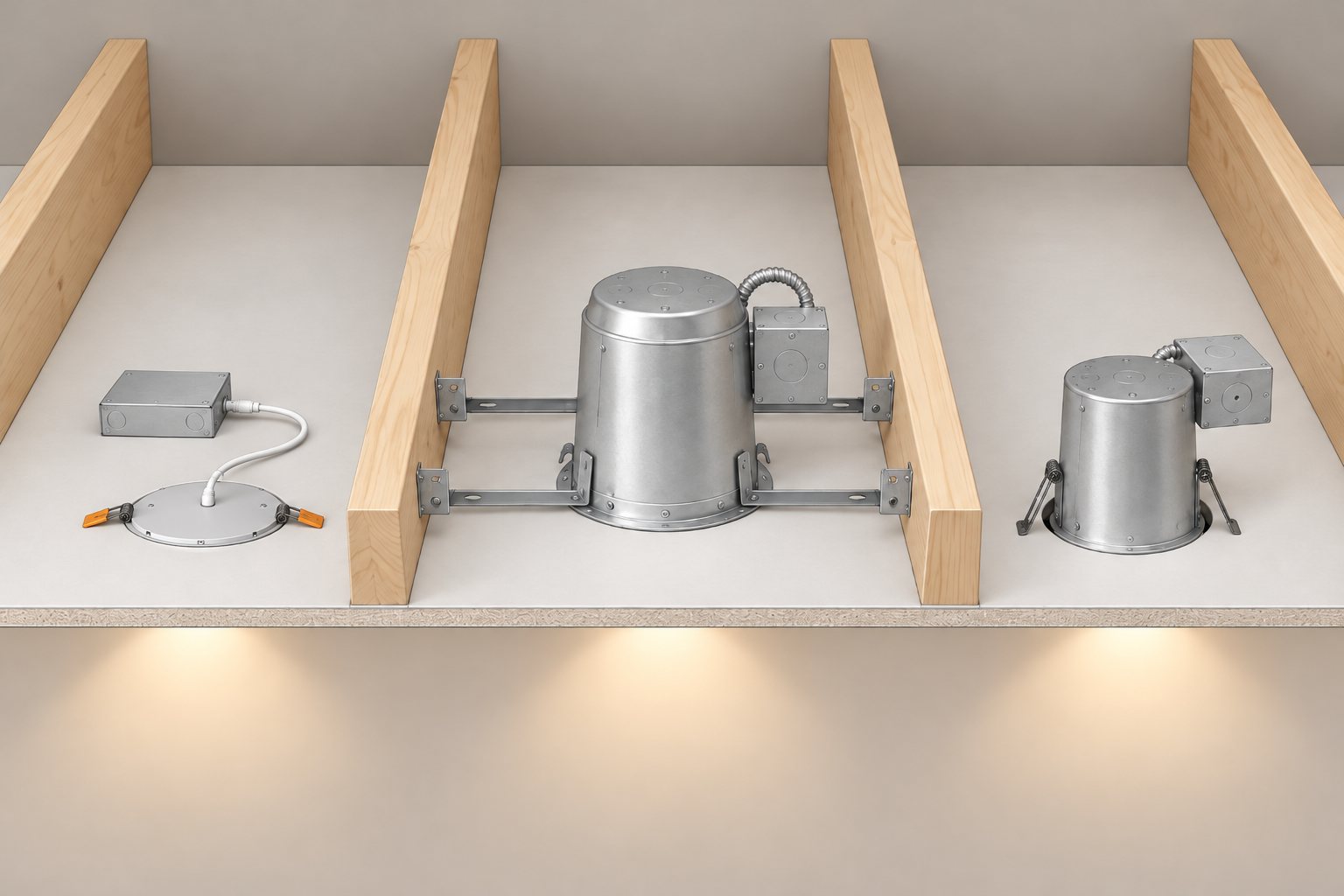
| Canless wafer | New-construction can | Remodel (cut-in) can | |
|---|---|---|---|
| How it mounts | A thin LED disk with spring clips, wired to a small box that sits on top of the ceiling. | A metal housing on bars nailed to the joists, set before drywall. An LED trim clips in after paint. | The same kind of housing, pushed up through a hole in a finished ceiling and held by clips that grip the drywall. |
| Best fit | Both new and finished ceilings, especially shallow spots under ducts, pipes, beams or in soffits. | New homes, additions and gutted rooms where the ceiling is open. | Adding lights to a finished ceiling without tearing it out. |
| Look | Sits nearly flush with a flat lens. Clean and simple, but you see more of the bright surface. A few models have a deeper, regressed look. | The light sits up inside the ceiling, which cuts glare. The widest choice of trims: smooth, ribbed, adjustable and shower-rated. | Same trims as a new-construction can. |
| Position | Very flexible; can go almost anywhere there's an inch of room. | Placed exactly where planned, fixed solidly to the framing. | Has to land between joists, so the layout may shift a few inches. |
| If the light fails | Replace the whole fixture. It unclips from below, so it's a quick job. | Swap the LED trim; the housing stays. You can also change trim styles later. | Same as a new-construction can. |
In most cases, canless wafer lights are the way to go. They cost less, install quickly, fit almost anywhere and give clean, even light. A can makes sense when you need a specialty trim, like an adjustable or deep regressed one, want to use a particular bulb, or are going for a specific look or feel.
What to know whichever type you choose
Insulated, airtight ceilings
Under an attic, lights must be rated to touch insulation and be airtight, or warm air leaks into the attic and causes frost. Canless lights and modern cans both qualify.
Size
2, 3, 4 and 6 inch. Smaller looks more modern but takes more lights to cover a room.
Sloped and wet locations
Vaulted ceilings need housings or trims made for a slope, or the light aims at the wall. Over a shower or tub, the light must be rated for wet locations.
Outlet types
- Traditional (duplex) Two rounded faces with a center screw. Goes with toggle switches.
- Decorator A flat rectangle that matches rocker switches and shares their plates.
- GFCI Test and reset buttons. Cuts power in a split second if current leaks, as it can around water.
- USB charging One plug plus USB-A and USB-C ports. Handy at nightstands, desks and kitchen counters.
Tamper-resistant
Built-in shutters keep kids from pushing things into the slots. Required today, and plugs take a firmer push at first.
Where GFCIs go
Kitchens, baths, laundry, garages, basements and outdoors. One GFCI protects the outlets after it, so a dead bathroom outlet often means a tripped GFCI nearby.
Outdoor outlets
Weather-resistant outlets with covers that close over a plugged-in cord. Plan spots for holiday lights, a pump or a block heater.
Hidden and specialty outlets
Pop-up outlets in a counter or island, floor outlets, outlets inside drawers for charging, and a recessed outlet behind a wall-mounted TV.
Dimmers and smart switches
Almost any light can be dimmed or controlled from a phone. A few things need deciding before the walls close.
Matching dimmers to LED lights
Flicker or buzzing usually means the dimmer and LEDs don't match. We check them against the maker's compatibility list.
The neutral wire
Many smart switches need an extra wire in the box. Tell us before wiring if you might want smart controls.
Smart switches and dimmers
Control lights from your phone, on a schedule or by voice. Systems with their own hub, like Lutron Caséta, tend to be the most reliable.
For homes you're away from
For a seasonal home, lights can run on a schedule and be checked or turned on from away.
Keypads and scenes
Whole-house systems with keypads that set several lights at once. They cost more and are planned with the wiring.
Choosing the color of your light
LED light comes in shades of white measured in Kelvin (K). Lower is warmer, higher is cooler.
- 2700K
- Warm. Close to an old incandescent bulb.
- 3000K
- Warm white. A little crisper than 2700K.
- 3500K
- Neutral. Neither warm nor cool.
- 4000K
- Cool white. Often used in garages and workshops.
- 5000K
- Daylight. Bright and slightly bluish.
You'll find this same scale on the back of most bulb and fixture boxes. Seeing a sample light in your own space is still the best test.
Keep it consistent
Use one color temperature in rooms you can see at the same time, or it looks patchy.
Color accuracy (CRI)
A CRI of 90 or higher makes wood, paint, food and skin look natural.
Selectable color
Many fixtures have a switch to set the color at install, which makes matching and changing easy.
Lighting under and inside cabinets
Light right on the counter where you work. Choose the type of light and how it's powered.
Puck lights
Round lights that make pools of light. Better for glass cabinets and shelves than a work counter.
Light bars
Slim linked fixtures with even light and a simple install.
LED tape
A strip of LEDs in a frosted channel. The most even line of light, with a small hidden power supply.
Hardwired or plug-in
Hardwired runs to a switch with no cords showing and is planned before drywall. Plug-in is easier to add later.
Backup power for outages
Up here a storm can knock power out for a day or more, and with a well that means no water too.
Transfer switch for a portable generator
A small panel wired to the circuits you choose, like the well pump, furnace, fridge and a few lights. You plug a portable generator into a power inlet box outside and switch over. Much less expensive, but someone has to be there to run it.
Whole-house standby generator
A permanent propane or natural gas generator that starts on its own within seconds, whether or not anyone is home. It needs yearly service and a spot that meets the maker's clearances, so it's best planned with the house.
Internet, TV, speakers and cameras
Cheap to run while the walls are open, and hard to add later.
A home for the network
A closet or utility spot where the internet comes in and the router lives, with an outlet. Wiring runs out from there.
Wired internet (Ethernet)
Faster and steadier than Wi-Fi. Run it to the office, behind TVs, and to ceiling spots for Wi-Fi access points.
Satellite and rural internet
Plan where the dish or antenna goes and how its cable reaches the network spot.
Cameras and doorbells
Wired power for a video doorbell and cameras means no batteries. Mark where you'd want to see.
TV walls
A recessed outlet, data and a conduit down to the media spot, so cables can change later.
Speakers
Wire for in-ceiling or porch speakers and the spot for the receiver.
Product and company names on this page are trademarks of their owners and are used only to identify those products as examples. Birch Cove Builders is not affiliated with or endorsed by these manufacturers.
More guides
Outside the house
Systems
Have a question that isn't here?
Send it our way. If we hear it often, it'll likely end up in one of these guides.